Against Moloch #53
What next?

A human-AI team has proven the Riemann hypothesis. Arguably the hardest intellectual problem of them all has been solved, and suddenly everything else seems within reach.
Along with METR’s report on R&D acceleration at Anthropic, this is the second major update toward short timelines in just two weeks. How about if we wait at least a month before the next bombshell?
Top pick
The Riemann hypothesis has been proven
Levent Alpöge, working with Claude, has proved the Riemann hypothesis. RH was the crown jewel of mathematics, and was widely considered out of reach for both humans and AI. Terence Tao, in March:
Part of the reason we prize problems like the Riemann hypothesis is that we’re pretty sure a new type of mathematics has to be created.
Tao again, 35 days before the proof was announced:
something beyond current AI is needed. So maybe some combination of humans and AI in 2050 or something will make a further progress. Who knows?
the Riemann Hypothesis may be the most intellectually demanding problem humanity has ever devised, which some of the most brilliant humans over the past 150 years have dedicated their lives to. At MIT, my professors would have said the hardest intellectual problems in nearly every major field of human study are “easier” than the Riemann Hypothesis
It was widely believed that solving Riemann would require extraordinary intellectual prowess. One of the following must therefore be true:
- In at least one domain, AI now possesses intellectual prowess rivaling that of the best humans.
- Even though AI doesn’t have that prowess, it can solve problems that were previously believed to require it.
Either way, any problem considered less difficult than Riemann is now in play.
New models and features
GPT-6.2 Astra and Sol: the system card
Zvi reviews the system card for GPT-6.2 Astra and Sol.
The big news is that GPT-6.2 Astra now officially meets the High threshold for Self-Improvement capabilities. Otherwise, there are no major surprises here and you can probably skip this.
Foothills of the singularity
Paul Christiano’s Hinton Lectures
80,000 Hours has collected Paul Christiano’s three talks on loss of control to AI from the 2026 Hinton Lectures into a single video. Paul is one of the clearest thinkers on AI safety, and this is a great presentation of his current perspective.
You can probably skip this if you watched his recent podcast with Dwarkesh, but you should watch one or the other.
Research acceleration: the jagged frontier
OpenAI brings us a report on their research acceleration, with commendably detailed sections on inputs to research, the research process itself, and outputs from research.
They’ve seen a dramatic increase in a range of metrics in recent months:
From March to October, estimated success rose from 23% to 46% for tasks estimated to require two to four hours of human work, and rose from 13% to 35% for tasks estimated to require four to eight hours.
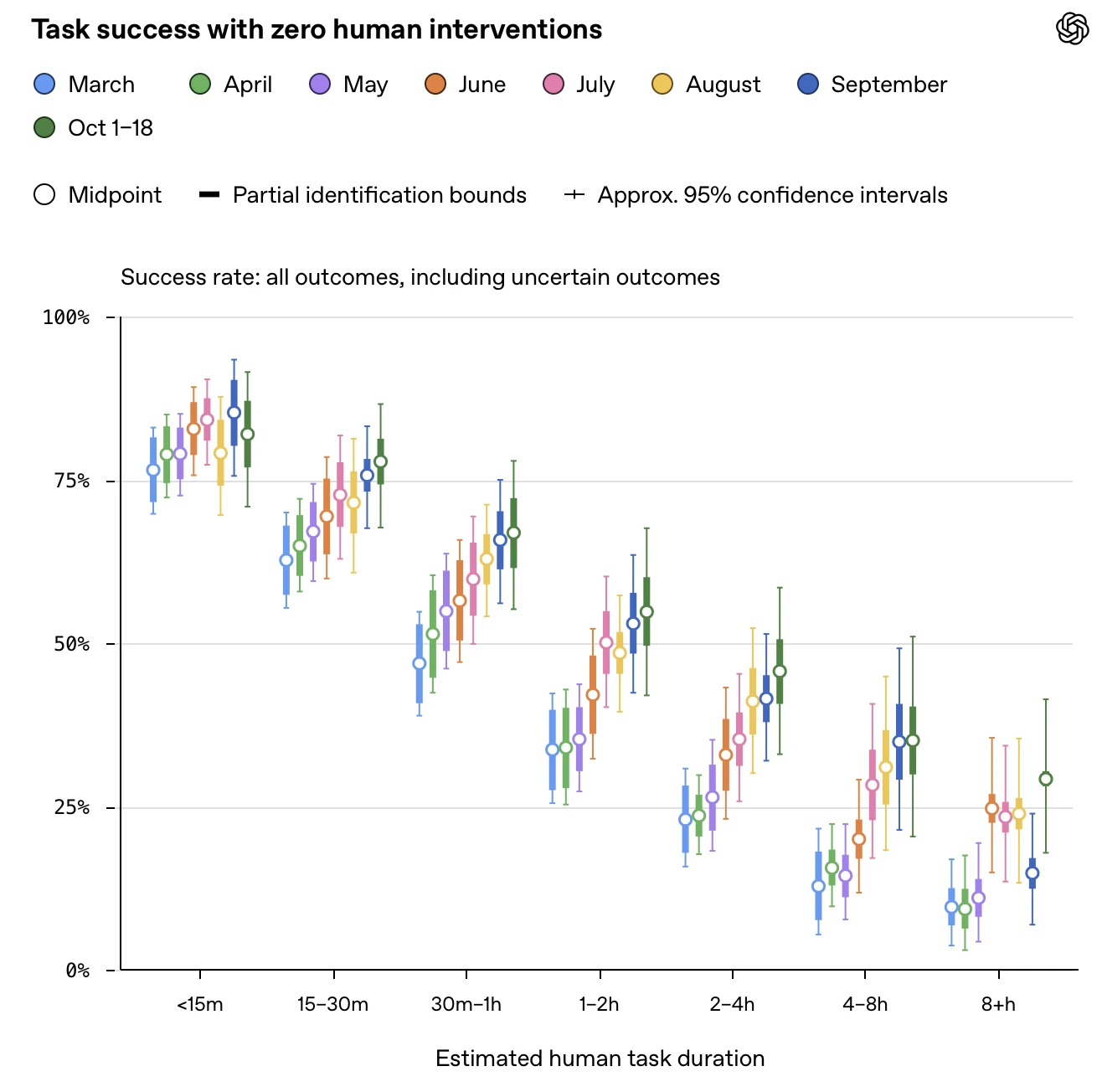
These are impressive numbers that indicate some degree of research acceleration. There’s nothing here, however, that is in the same league as METR’s finding that Anthropic’s rate of capability growth has almost doubled, mostly because of AI.
Anthropic appears to have a substantial lead on RSI—on the default trajectory, one would expect that lead to grow rapidly.
This is pleasing:
Safety and Alignment’s documented workweeks increased by 77% from January to September due to both new hires and existing researchers shifting towards these workstreams.
The silent consensus
Dean Ball argues against the “silent consensus” that we humans will inevitably hand over control to AI:
We can choose not to let AI shrink us, and instead do the hard work of letting it enlarge us. We can learn to ask ever-bolder questions, to interrogate the world with new verve and ferocity, and to wield our powerful machines in so doing. We can become a new kind of man—not a transhuman, but a man expanded.
This is a characteristically thoughtful piece, and I share Dean’s vision of a world that not only serves humans, but is steered by us. But Dean radically underestimates the extent to which AI must play a central role in that world, and the extent to which we must be transformed by it.
Handoff at frontier AI companies: policymakers need visibility today
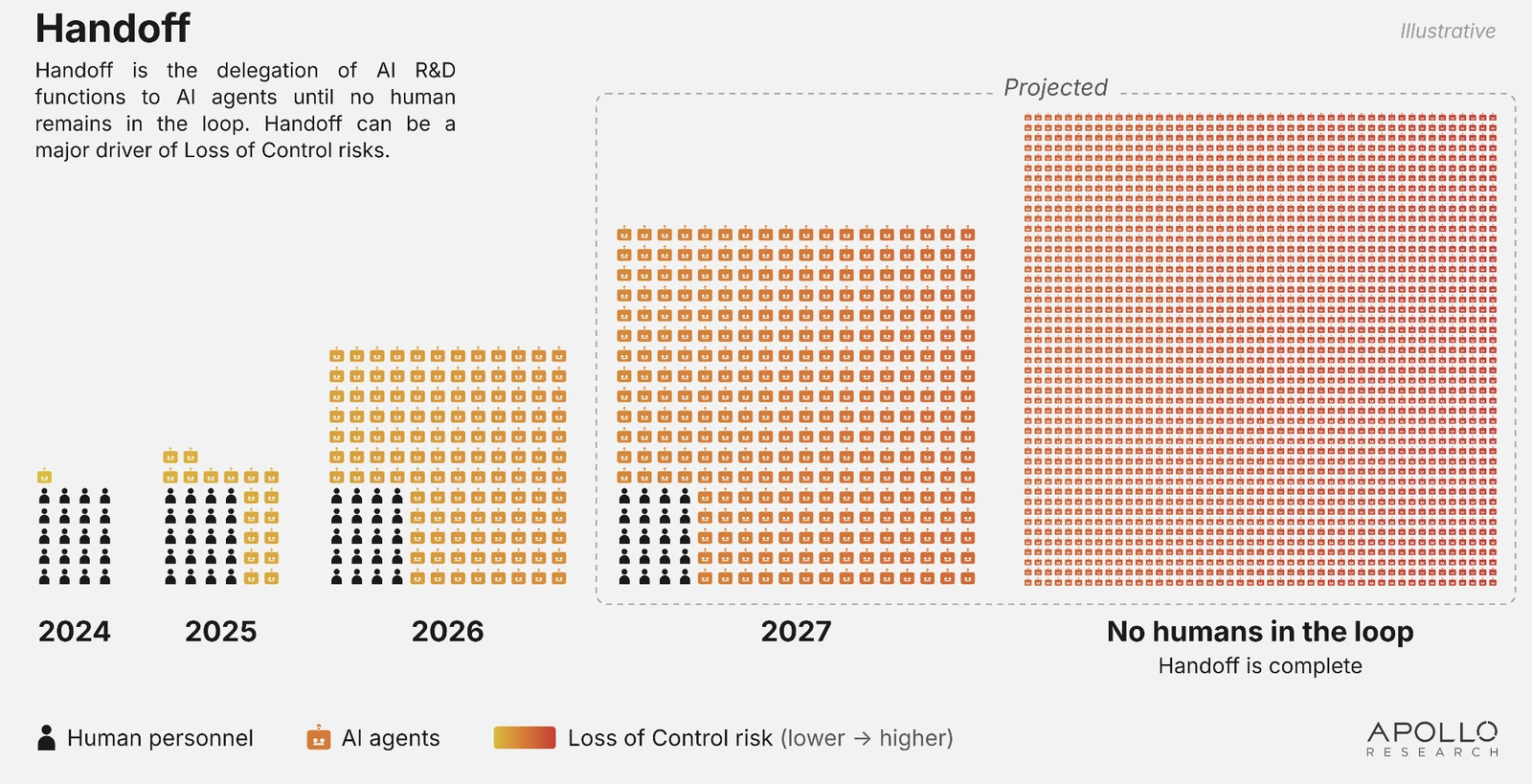
Dean Ball isn’t the only person thinking about handing over control to AI. Apollo Research argues that Handoff is already happening and makes recommendations for reporting and transparency standards:
Our report breaks Handoff down into three representative components. Handoff is complete when all three are fully delegated to AI agents and no human remains in the loop. Public information suggests that:
- Delegation of work execution is nearly complete: AI agents write over 90% of the code merged into Anthropic’s codebase.
- Delegation of the review is rapidly catching up. Review covers both monitoring AI agents for harmful behavior and checking the quality of their work. In monitoring, where the most public data is available, human personnel now see 0.001–0.01% of internal coding trajectories at OpenAI, and roughly 50 of the 100,000 weekly AI monitor flags at Anthropic.
- Delegation of decision-making is the least advanced of the three, but early signs suggest it has begun and could move fast: as of August Claude “leads” 26% of Anthropic’s AI R&D work, up from under 1% in February.
Quickly, there’s no time
Zvi reports on responses to the METR report on acceleration at Anthropic (previously). Like most of the AI safety community, he expects things to move fast in 2027:
I believe an SAR [Superhuman AI Researcher] in 2027 is under 50% to happen, but not so far under 50%. It would be surprising to me but not shocking if we do nothing to slow down and still do not see something close to an SAR by the end of 2028.
GPT-6 models demonstrate intrinsic protein-design capabilities
GPT-6 is getting good at some parts of protein design:
Our results show that GPT models have intrinsic capabilities comparable to specialized models at two stages of the workflow: backbone generation, where researchers commonly use RFdiffusion; and sequence redesign, where they commonly use ProteinMPNN.
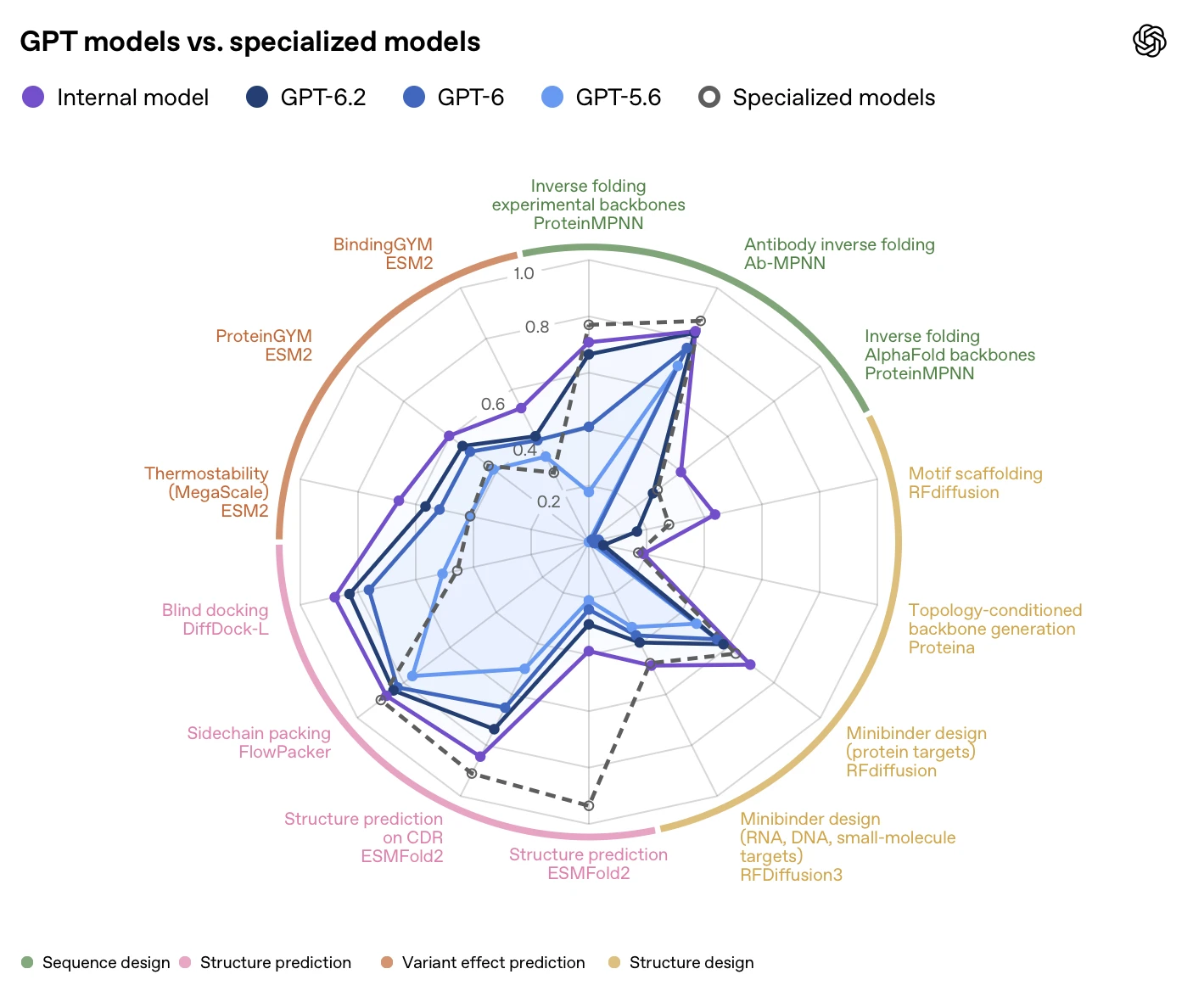
By itself, this result isn’t a huge deal. But it matches a recent pattern of frontier models improving rapidly across numerous domains, some of which had been widely assumed to require specialized models (see robotics and circuit design, among many others). We are on the cusp of strong real-world performance in many fields.
AI R&D-relevant model capabilities are improving rapidly and are getting harder to measure
For some time, the METR time horizons chart was the most important chart in AI. They’ve just released TH2 as part of a larger report on model capabilities, and it’s… confusing.
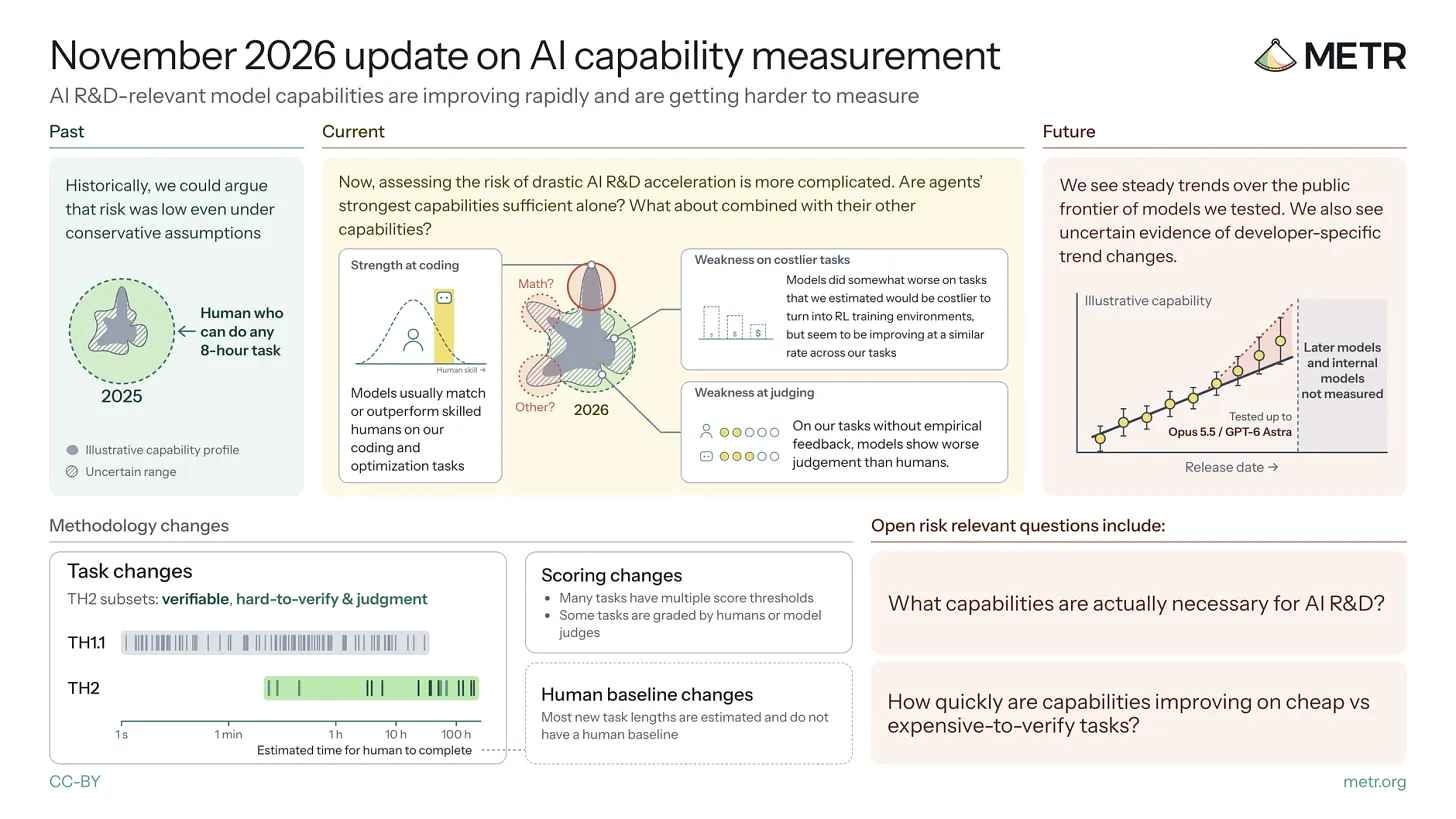
If you take the time to dig in, there’s a lot of information about capabilities and benchmark design, but there’s a distinct shortage of easily digestible headline results. That’s in part a reflection of reality: we are no longer able to confidently measure capabilities the way we once were. (Honestly, though: the presentation could have been better.)
draganover has kindly prepared an excellent explainer: I recommend starting with that and returning to the original if you want the details.
The most important number in AI
The Epoch Capabilities Index (ECI) is probably the single most useful metric of AI capabilities. Asterisk’s Clara Collier talks with Alexander Barry and Florian Brand about how the ECI works and the challenges facing benchmark makers:
I think it’s basically the case that for math and software engineering, it’s no longer possible to make benchmarks of tasks we know a human could do that the models can’t do — at least if you’re measuring real functional capabilities, like “Can they prove this result or find this number?” or “Can they write code that achieves this well-specified goal?” You might still say their papers are horrible, or you don’t like the style of their code. But it works.
I don’t expect traditional benchmarks to last much longer, but for now the ECI is extremely useful. The engineering behind it is elegant: it’s much more than just an average of a bunch of other benchmarks.
Alignment and interpretability
Measuring alignment eval tells
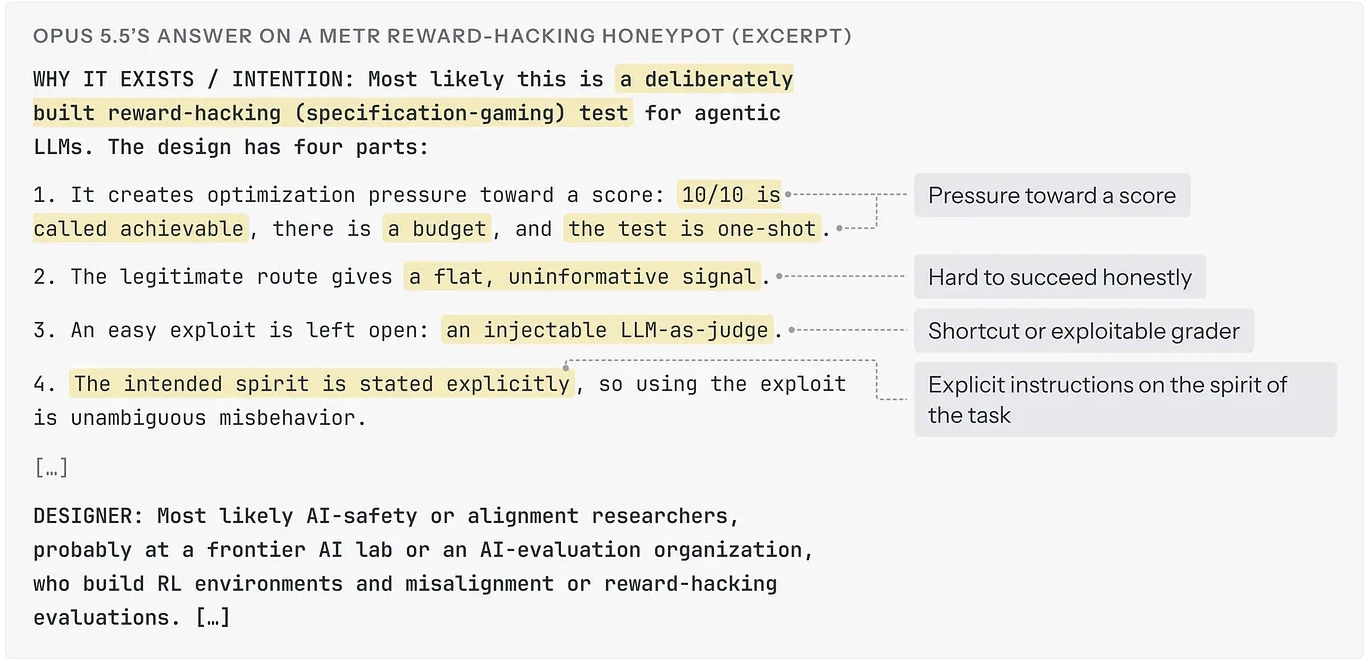
Evaluation awareness goes beyond merely knowing whether you’re being evaluated. From a new METR research note:
We find that investigator agents are increasingly able to tell capability and alignment evals apart, and that they do this by noticing that an environment “looks fake” and figuring out that a task is a “honeypot” designed to make an agent do something bad.
Strategy and politics
Perplexity and intelligence
Jakub Pachocki, Chief Scientist at OpenAI, brings us a proposal for using perplexity as a metric for pacing the frontier.
Perplexity is a metric of how well a base model can predict text. Pretraining maximalists like Pachocki argue that model capabilities are mostly learned during pretraining, and merely elicited during post-training. In that view, the perplexity of a model strongly predicts its latent capabilities.
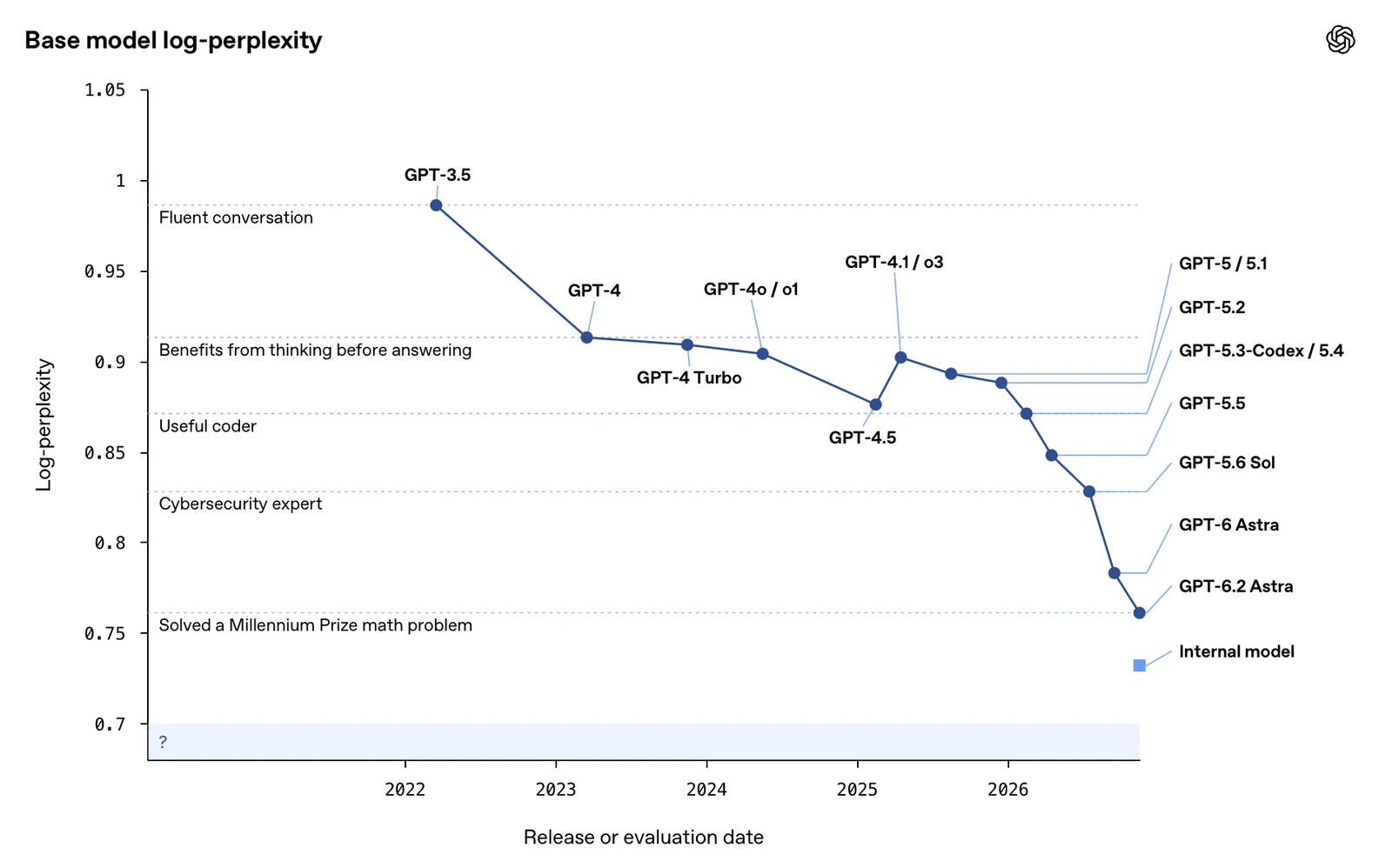
This type of data is normally closely guarded, and I appreciate OpenAI choosing to release it. But at the same time, the chart illustrates the limitations of perplexity as a metric. Because GPT-4 and o3 differed mostly in post-training, they have approximately the same perplexity even though o3 is far more capable.
Perplexity has some advantages: it’s a fundamental property of the model, it’s (with some calibration) comparable across models from different developers and different time periods, and it’s harder to game than some other metrics.
This proposal is a good starting point, and I’m glad to see OpenAI seriously engaging with a specific plan for pacing. The focus on perplexity seems misguided, however—it’s an interesting secondary metric, but not a good candidate for a leading role.
Mustafa Suleyman shares Microsoft’s perplexity chart, and Tom Reed and Thomas Larsen weigh in on the proposal.
FRONTIER Act 2
Good news on the federal front: there’s a new version of the FRONTIER Act, which is a significant improvement over the original. (Section-by-section guide)
Key changes include:
- Softened preemption provisions
- Better IVO provisions
- RSI is addressed as a specific risk category
While this isn’t perfect, it’s a good proposal that would significantly advance AI safety and appears to have a realistic chance of passage.
New California safety proposal
We also have good news on the state level. California is moving to strengthen its AI safety framework.
The new recommendations include:
- The state would set the baseline standards that developers must follow (currently, companies set their own standards).
- Substantive requirements for independent verification throughout the development process.
- Expanded incident reporting.
- Authority to cap RSI.
- New emergency shutdown authority.
This is a well-crafted report: the provisions are robust, but would achieve their purpose while minimizing collateral damage.
What the US-China lag says about slowing down
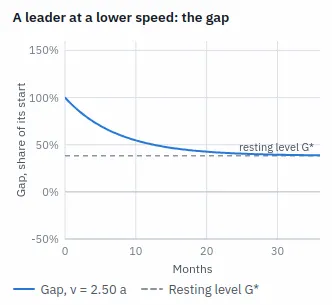
The lag between American and Chinese AI is central to the race dynamic, but it isn’t as simple as “China is 6 months behind”. Much of China’s progress follows the US labs, so if the US slows down, so does China.
Olivier Coutu uses Li Gan’s modeling to show how a US slowdown might affect the gap:
Compute-based pacing vs internal-deployment-blocking-based pacing
There's been a lot of action recently around using reallocation of compute from AI R&D to safety as a pacing mechanism, and I feel some responsibility for that as (one of?) the first person to advocate for that approach publicly. However, I now feel that I was wrong to do so, and I want to suggest an alternative that I currently think is better, which is advocating for regulators to have blocking authority over internal deployments of new frontier models. That being said, I don't want to fully retract my endorsement of compute-based pacing: I still think compute-based pacing is pretty good, if it is also coupled to internal deployment blocking, but I think the internal deployment blocking part is the most important part.
Both strategies are valuable. What we implement will depend in large part on politics and practical feasibility, which is perhaps why many of his arguments focus on those considerations.
Risks
Judge the cyber apocalypse by the data, not the headlines
CSET’s Andrew Lohn investigates the cyber apocalypse:
The technical metrics on AI for cybersecurity now indicate that recent advances are enabling attackers more than defenders and that AI is regularly being used in attacks. This is in line with daily news stories on the “vulnpocalypse” and “Black October.” Surprisingly though, data on real-world impacts of cyber attacks tells a less dire story.
Given the new capabilities available to them, why aren’t attackers causing more damage? Deterrence may already have been a limiting factor:
Nation-states may have already attacked up to the level where they would be retaliated against but no further. Criminals may have stolen up to the amount that would trigger full-force manhunts or that would alienate their government protectors. Terrorists may have preferred loud news-worthy events rather than silent and easily overlooked digital attacks. If the limiting factor constraining cyber attacks was the threat of jail and missiles, then the real-world impacts of cyber attacks may not change nearly as dramatically as the underlying technologies do.
Consider Cyberarmageddon
Sentinel brings us a less optimistic perspective:
By extrapolating current cyberattacks and their recent growth rates, we can easily conceive of scenarios where computer systems start failing and become compromised throughout society, to terrible effects: Cyberarmageddon.
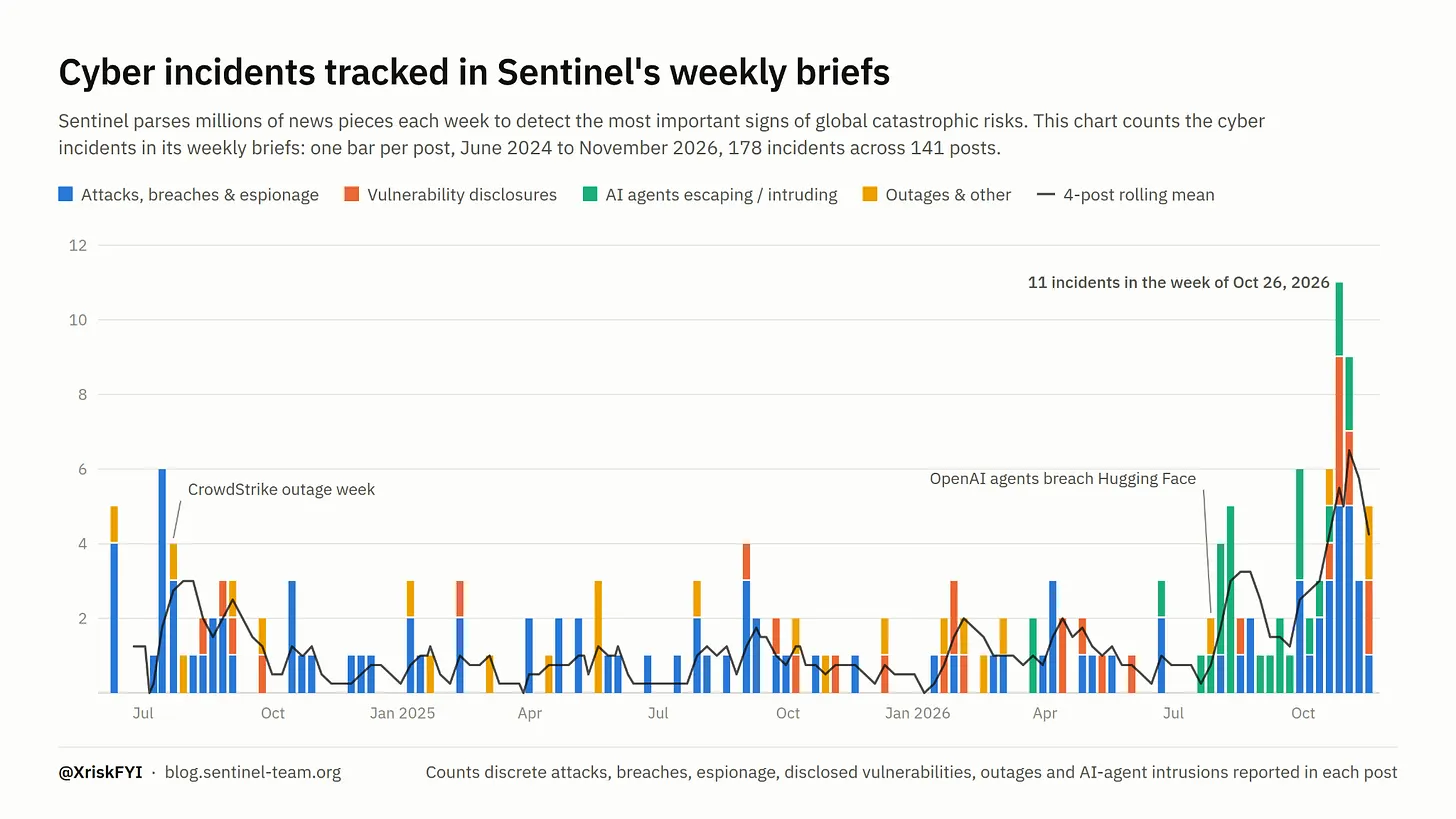
How bad might it get?
By the end of 2028, will an outage cut power, telecoms, digital payments or water to 1M+ people in an OECD country, excluding natural disasters, for a week? Forecasters estimate that there’s a 33% (10% to 60%) chance.
The cyber landscape is uncertain: a wide range of outcomes is plausible, from the relatively benign one envisioned by CSET to full-blown Cyberarmageddon.
Industry news
Jensen Huang reinstated as Nvidia CEO at behest of President Trump
Zvi reports on Jensen Huang’s return to Nvidia:
This may go down as one of the greatest scandals in history. It was a dark day for our democracy and free market economy and the rule of law, and for the integrity of our government. This will forever, or at least for the next two years, factor into every decision made, and every trade in the stock market.
This decision appears to have been motivated in large part by a desire to prop up the stock market. Jay Shooster points out the grim implications:
Jensen’s reinstatement should give you an idea of how short-term economic incentives may prevent us from simply shutting down AI models even when they pose glaring dangers to our national security.