
Writing With Robots, Part Two
Establishing the guiding principles
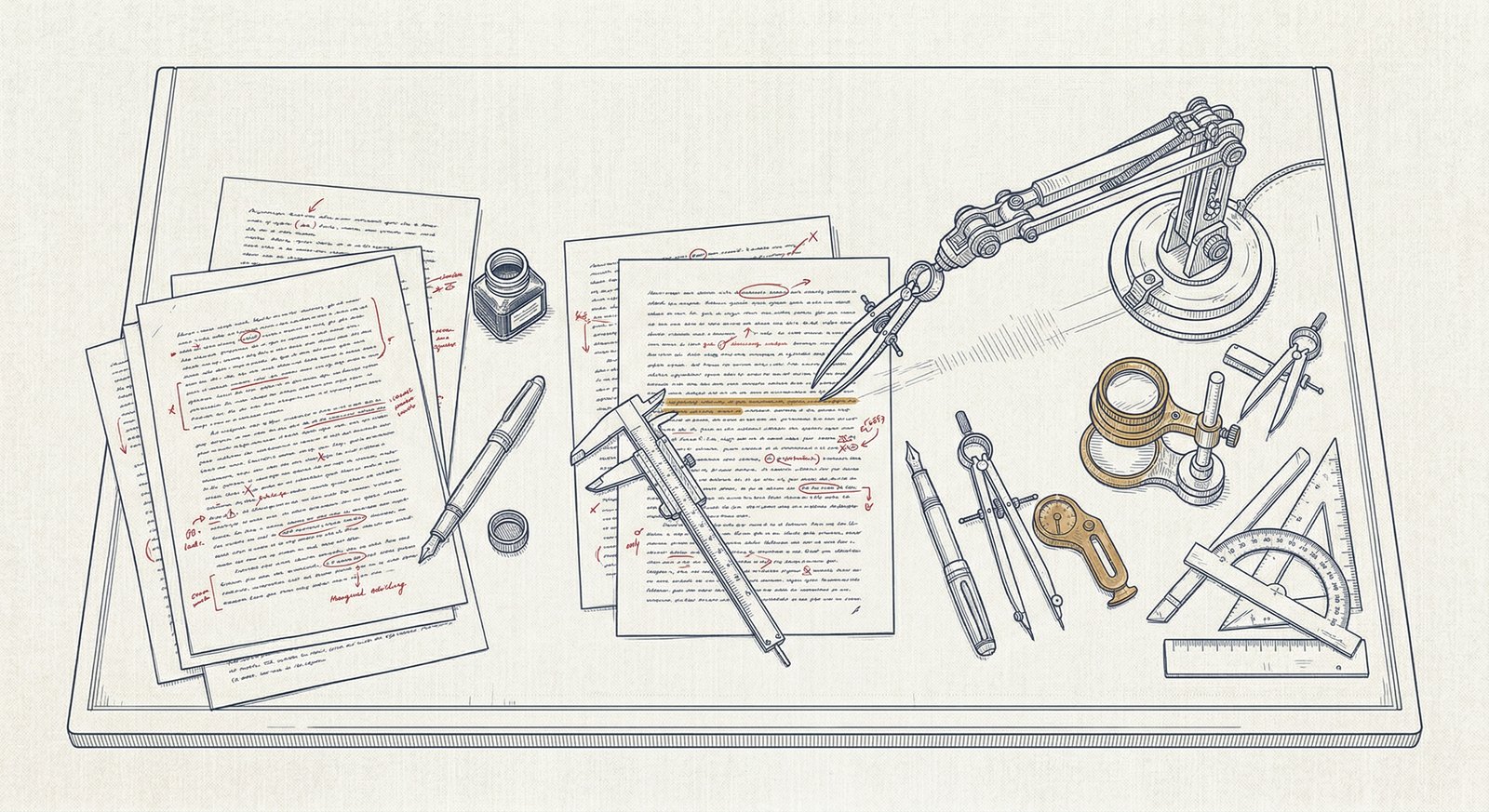
Let’s dive into the second part of the style guide, which lays out my high-level goals for everything I write.
High-level goals
Accuracy: always say what is true
Truth, accuracy, and epistemic precision are top-level goals for me personally as well as in my writing.
Do I have my facts right?
To the best of your ability, please flag any incorrect or questionable claims.
It was important to Claude to clearly convey that it isn’t able to provide comprehensive fact checking. I’m still working on good scaffolding for that, especially since some sites block AI access. I also want to give the editor access to whatever brainstorming and research occurred earlier in the process.
Do I accurately convey epistemic status?
There is a tricky balance here that I’m still calibrating. My writing conveys my perspective and my opinions, and it is neither necessary nor desirable for me to preface my statements with qualifiers like “I think” or “it seems to me”.
At the same time, I don’t want to present my opinions as settled facts.
Example: instead of saying “I think MechaBrain might be unreliable” or “MechaBrain is unreliable”, say “it is not clear whether MechaBrain is reliable”.
This section of the guide is still in active development. My natural style is to hedge everything, and Claude has been great at fixing that. But it sometimes pushes me to be too definitive, and I haven’t yet found instructions that strike exactly the right balance.
Is my reasoning correct?
It’s fine for my writing to have opinions, but my arguments should be sound and my conclusions should follow from my premises. Please be proactive about flagging questionable logic.
Am I missing important nuance or perspective?
I don’t need to cover every possible perspective or include every minor aspect of what I’m discussing, but if I’m missing something large and relevant, please call that out. It is very helpful for you to tell me about sources or viewpoints I may not have been aware of if they are directly relevant to the piece.
Example: when I wrote about Anil Seth’s position on AI consciousness, you told me that even though I was accurately representing his position in the piece I was critiquing, he had made a stronger version of the same argument elsewhere. That was very helpful and helped me write a better piece.
Names should be spelled correctly
It’s particularly important that names of people, organizations, and things be correct.
Example: you caught me referring to the Berggruen Prize when I actually meant the Berggruen Prize Essay Competition, which is a different thing.
Summaries should accurately capture the gist of what they summarize
Especially in the newsletter, I will often summarize the content of an article that I link to. Please make sure my summary accurately captures the gist of the article unless it’s clear that I’m just talking about a specific aspect of it.
Insight: the forest, not the trees
This is one of the most important parts of the guide, but as with the section on epistemic accuracy, it’s been hard to find the right balance. Claude pushes me to go beyond mere facts to offering genuine insight, which is great. But sometimes, especially in my newsletter, I just want to share information: trying to hammer a profound insight into every news item is neither possible nor desirable.
Insight, not just facts
I want to offer significant insight that goes deeper than what is obvious. In some cases, especially in my newsletter, it is correct and appropriate for me to simply note that an important thing happened. But in almost all cases, people read me to understand not simply what happened, but what it means and what consequences it will have.
Example:
- Superficial: “Jack Clark says that when Claude was allowed to end conversations, it seemed to have an aversion to conversations about highly distasteful topics”.
- Partly insightful: “The fact that Claude’s aversion extended beyond what it had been explicitly trained on is further evidence of moral generalization.”
- More insightful: “Claude expressing active moral preferences in this way has implications for the current debate about whether alignment should target obedience or virtue”.
I would love for a reader to finish a piece feeling that they’ve come to understand something surprising and important. Not all topics contain profound insights, and I don’t want to force pseudo-insight into a piece where it doesn’t belong.
Always find the forest, not the trees
Please point out whenever I’m missing the forest for the trees. If a piece doesn’t leave the reader with a genuinely new insight, it almost certainly isn’t ready for publication.
Reframe the debate, challenge false binaries
At its best, my writing doesn’t merely offer new insight, but reframes the debate. I want to offer clear, useful models for thinking about complex topics.
Example: “This paper focuses on how to convince OpenBrain that safety testing is affordable, but that misses the point: they resist safety testing because of the liability it would create. We need instead to focus on safe harbor legislation that would remove the financial risk associated with safety testing.”
Clarity: make hard things easy to understand
“You aren’t writing clearly because you aren’t thinking clearly.”
One of my strengths—and something I want to center—is my ability to think clearly about hard things, and to communicate clear understanding of hard things. Ideally, I want my readers to read a piece about a complicated topic and leave wondering why they ever thought it was hard to understand.
Don’t stop at “I know everything in Claude’s Constitution and I can tell you what’s in there”, keep going to “I understand what is important in Claude’s Constitution, and I can help you understand why it’s structured the way it is”.
If my writing is convoluted or unclear, it might mean I need to polish my writing, or it might mean I need to think harder about my thesis. Either way, please push me to do better.
Quality: deliver maximum value per word
Zvi is a national treasure and adds immense value to the AI community. He’s valuable in part because he’s utterly comprehensive in his coverage, and that comes at the price of being less polished and curated.
My intention is to be toward the other end of that spectrum: I don’t aspire to being fully comprehensive, but I want to produce polished writing that doesn’t waste the reader’s time. The goal is to deliver comparable depth of insight at a fraction of the word count.
I need to regulate my natural inclination to polish my work forever and never finish it. Please push me to create high quality work, but also nudge me when a piece is good enough and I should publish it and move on to the next thing.
Claude was already pretty good at telling me when a section was done, but making the threshold explicit has been helpful.