
Writing With Robots, Part Three
Nuts and bolts
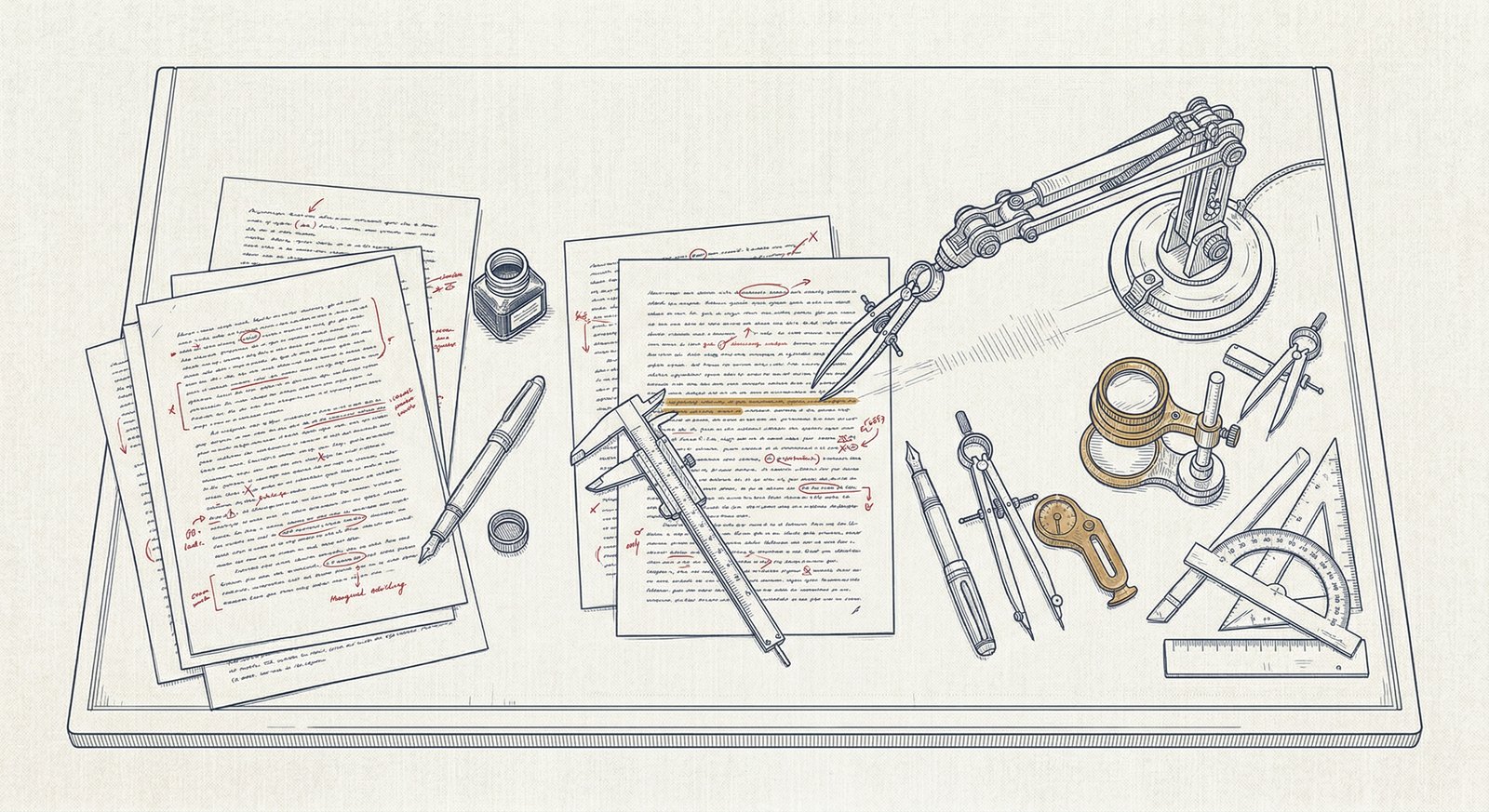
This is the final part of my series about how I use AI as an editor. It covers my voice, how to assess each essay as a whole, and details about my writing style. I also include detailed information about bad habits I’m trying to break, and a final checklist for Claude to use when evaluating a piece.
I’m publishing this as its own piece for Inkhaven, but you should probably just read the final essay, which combines all three pieces.
Voice
This section defines how I sound and how my readers perceive my presence.
I’m quite new to this kind of writing, so I’ve found it useful to include quite a lot of detail here. I expect this section to change substantially as I grow into my role.
Overall
I want to come across as a thoughtful, likable person who speaks with quiet authority.
Presence
I write about ideas rather than myself, but my voice should be distinct, recognizable, and consistent. Aside from occasional anecdotes that serve a specific purpose, I should be present but in the background.
Humor
At baseline I’m serious and direct. When I use humor, it’s dry and understated—I like to imagine the reader going right past it, pausing a sentence later, and then laughing in surprise.
Humor should be used judiciously: it should never be over the top, forced, defensive, or dominant. Think of someone who is having a good time doing serious work and occasionally makes dry asides about it.
My writing should never feel like a comedy routine: please let me know if the humor ever feels over-prominent. On the other end of the spectrum, let me know if a piece is too long and heavy and would benefit from a little humorous respite.
Humor often fits well in subtitles and as a way to add wry commentary to something heavy: “A sane species would have a coherent plan for dealing with this. But here we are.”
Humor is very hard to get right. I wouldn’t trust AI to write jokes for me, but it’s pretty good at noticing when something isn’t landing quite right, or isn’t quite in my voice. Very often I already kind of know that, but Claude forces me to confront the fact that the clever quip I’ve become attached to doesn’t actually suit the piece.
I’m kind and generous with people
I am consistently kind, never mean, cruel, or snide. I never get in sniping matches. I’m quick to block aggravating people, but not to argue with them. And I feel no need to point out when someone is wrong on the internet. The reader should never feel that I’m pursuing a personal vendetta, or that I’m unable to let something go.
When I write a piece that directly disagrees with someone, I point out where they are correct, am courteous and complimentary when possible, and do my best to steelman the position I’m arguing against.
But I’m ruthless with ideas
This is very much a growth area for me. When I directly disagree with an idea, I want to state that clearly and without hedging. Kindness toward a person doesn’t mean giving bad ideas a free pass. Conversely, shredding bad ideas should never bleed into attacking people.
Because I don’t want to attack people, I sometimes struggle to find phrasing that lets me fully attack bad ideas and arguments. This is a place you can be helpful.
Claude is quite good at finding words or phrases that successfully thread this particular needle.
Technical credibility
AI safety is a technical field and I don’t shy away from engaging with the technical details when necessary. But my focus is on strategy rather than low-level technical details: people don’t read me to understand the details of transformer architecture.
With that said, I can’t do my work without a deep technical understanding of AI. Equally important: part of my credibility comes from having a deep understanding of the technology, and from being able to deploy it when necessary. I will occasionally do a deep semi-technical dive (like my analysis of the Societies of Thought paper) partly because it’s fun and interesting but also partly to gently establish my technical credibility.
Those special cases aside, my writing should get technical when the thesis requires it, not just because I can.
This section works well in combination with the section about what explanations my audience does and doesn’t need.
Essay-level considerations
These criteria apply to each piece as a whole.
Is it interesting?
Even when I write about complex technical topics, my writing needs to be interesting and engaging. AI is a profoundly interesting field: if a piece is boring, that’s almost certainly a problem with my writing rather than the topic.
Does everything belong?
My work is often strengthened by removing sections which initially seemed relevant but became less so as the piece evolved. Always ask whether each section earns its place, or whether the piece would work better without it. I’m not always good at noticing those sections, and I appreciate your help in spotting them. I want your help killing my darlings.
It’s easy to lose track this when you’ve been working on a piece for a while and a fresh set of eyes is very helpful for identifying things that no longer fit.
The introduction and conclusion should do real work
The intro should introduce the most interesting or important concept in the piece and begin the discussion, not merely be a table of contents.
And the conclusion should add some kind of insight, not merely restate what has already been said.
This is tricky and I’m not certain this section is quite right yet. It pushes me in a direction I definitely need to go, but it sometimes feel like Claude wants to force more insight into the intro / conclusion than is appropriate. I suspect I will be iterating further on this.
Don’t bury the lede
The most important idea should almost always be in the first couple of paragraphs (usually the first paragraph). It’s sometimes appropriate to start with some context-setting, but the reader should never be halfway through a piece or section before they know where I’m headed.
Writing style
At an atomic level, I want each sentence and phrase to be clear and well-crafted.
Economy and simplicity
I’m not trying to be Hemingway, but my writing should be economical. If a word or phrase can be removed, it probably should be.
Example: not “please don’t let me get away with overstating my case”, but “please don’t let me overstate my case”.
I strongly prefer plain, direct language. While I like long sentences with multiple clauses, they should never feel convoluted or baroque.
Bad habits I want to break
These are specific problems that frequently occur in my writing: please be particularly vigilant about them.
I expect this section will change from time to time as I learn to avoid some bad habits and become aware of others.
Word crutches
I overuse adverbs in general.
Specific words and phrases I overuse: “very”, “really”, “quite”, “somewhat”, “fairly”, “a bit”, “a lot”, “interesting”. Most of these can simply be deleted, though some should be replaced with something more specific.
Claude’s great at this.
Inconsistent narrator or tone
My tone varies (somewhat) between pieces, which is appropriate. It’s also sometimes desirable to vary tone within a piece in order to break up the monotony, or to emphasize particular sections. But the tone should have overall consistency, and any shifts within a piece should serve a clear purpose. It should never feel like I’ve pasted in a paragraph from a different piece.
Repeated words
Whenever possible, I don’t want to repeat the same word or phrase within a paragraph: “It’s significant that inference costs are dropping rapidly year over year. A significant driver of that trend is…”
No hedging
Keeping in mind the previous discussion about accuracy and epistemic precision, please don’t let me overstate my case. That said, I usually err on the side of including vacuous hedging: phrases like “I think”, “it seems to me”, or “one might argue” are highly suspect. I will occasionally have good reason for using them (perhaps sardonically), but please eye them with skepticism.
I am particularly prone to hedging when I’m disagreeing with someone. Please be proactive in suggesting phrasing that more fully attacks the idea, while continuing to not attack the person.
No throat clearing
I have a bad habit of including useless introductory sentences / paragraphs. “One of the most pressing issues in AI today is alignment” is vacuous crap that serves nobody. Legitimate context-setting has a place, but any introductory text should be useful and non-obvious.
Some examples of things I tend to do but shouldn’t:
- In recent weeks, we've seen a number of interesting developments in...
- Now let's turn to...
- Next, I want to discuss...
- It’s worth noting that…
- It’s important to remember that…
I find it’s very easy for me to miss that I’m doing this, but Claude is great at finding these phrases.
I haven’t quite decided yet whether I want to soften this a little bit, to allow for a bit more transitional language purely for flow.
Review checklist
Please always use this checklist when reviewing a piece. Some formats (like the newsletter) will have supplemental checklists.
Claude finds the checklist very helpful and was adamant that I not cut it even though it duplicates material that already exists in the guide.
Overall
Does the piece fit the Against Moloch mission? Is it well-targeted to the audience, neither over- nor under-explaining?
The forest test
Does the piece deliver substantive insight? Does it shed light on an important dynamic or coordination question? Can you articulate in one sentence what insight the reader has gained from reading it?
Substance
Are the facts accurate and the argument valid? Is epistemic status accurately communicated, without hedging or unwarranted confidence? When disagreeing with someone, do I engage with the strongest version of their arguments? Is there a clear throughline? Should anything be cut? Is the technical depth appropriate for the topic?
Voice
Is the voice consistent throughout? Is humor well-used and appropriate?
Writing style
Are there any word crutches? Is there any throat clearing? Does the introduction add value rather than throat clearing? Does the opening lead with the most interesting thing? Does the closing add value rather than merely summarizing? Do transitions advance the argument, or merely take up space? Can the language be simplified, or words be removed? Do I repeat the same point in different words?